
Paying Off Credit Card Debt
A goal many people have when budgeting is to pay off credit card debt. Weekly can help you set aside money each week for your payments, so paying down the balance is built into your Weekly Spending Limit instead of competing with it.
This article assumes your credit card is linked to Weekly along with your checking account. If the card is not linked, Weekly never sees the charges you make on it. In that case, do not ignore the payment. Count it against your Safe-to-Spend, or link the card.
If you pay your card in full each month
Whenever possible you should try to pay off your credit cards every month. This keeps you from accumulating debt and also avoids interest charges.
If you pay off your credit card balance each month you will have two transactions for the payment: the payment expense from your checking account, and an offsetting payment “income” transaction on your credit card. You already accounted for the spending when the original charges came in, so you can ignore both of these transactions.
Weekly usually suggests Ignore for both of them when your bank marks them as a payment or a transfer. If you don’t see the suggestion, choose Ignore yourself.
If you’re carrying a balance
If you’re working to pay down your credit card and are carrying a balance, you’ll want to take a few extra steps.
- Decide how much extra you can pay each month, on top of any new charges. Then make a recurring expense for that additional amount.
- Create a second recurring expense for interest. Estimate the interest you’ll accrue each month while you pay down the balance.
These two recurring expenses decrease your Weekly Spending Limit, so the money for those payments is set aside before you spend it.
It may be a good idea to stop using the credit card that’s carrying a balance, since you will accrue interest on all new charges until it’s paid off.
When the payment syncs
If you are still using the card, review your statement and pay off all the new charges from the past month, plus the additional amount you decided to pay.
If you make a single payment, split the transaction when it syncs. Assign the additional amount to the recurring expense you set up, and ignore the rest. The rest covers charges you already accounted for when you made them.
Ignore the matching payment “income” transaction on the credit card, the same as when you pay in full.
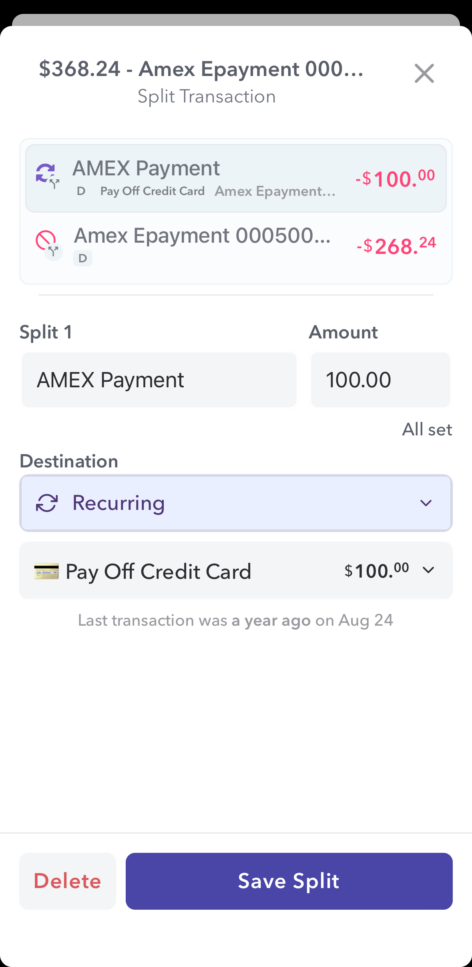
When the interest charge syncs
Your card will post an interest charge each month. Assign that transaction to the interest recurring expense you set up. If the amount is different from your estimate, Weekly asks how to handle the difference, and you can update the recurring expense to the new amount.
Paying off a loan or line of credit you don’t link
If you’re paying back a line of credit or loan that isn’t connected to Weekly, set up a recurring expense for the payment. That’s the easiest way to track it and make sure it’s accounted for in your budget.
Why credit card debt makes Available Cash negative
Weekly subtracts your credit card balances from your checking and savings to find your starting cash. It then forecasts your income, bills, day-to-day spending and fund contributions for the next 35 days. Your Available Cash is the lowest point in that forecast.
If you’re carrying a balance, your Available Cash may be negative even when there’s money in your checking account. The negative number is not your exact debt, because upcoming bills and income move it too. As you pay the balance down, your Available Cash rises.